

If you're a law student or a young lawyer dreaming of wearing the uniform, you've probably heard about the Judge Advocate General (JAG) entry. But there is still a lot of confusion around it. Is CLAT PG compulsory? How much score do you need? What really happens during the five-day SSB process?
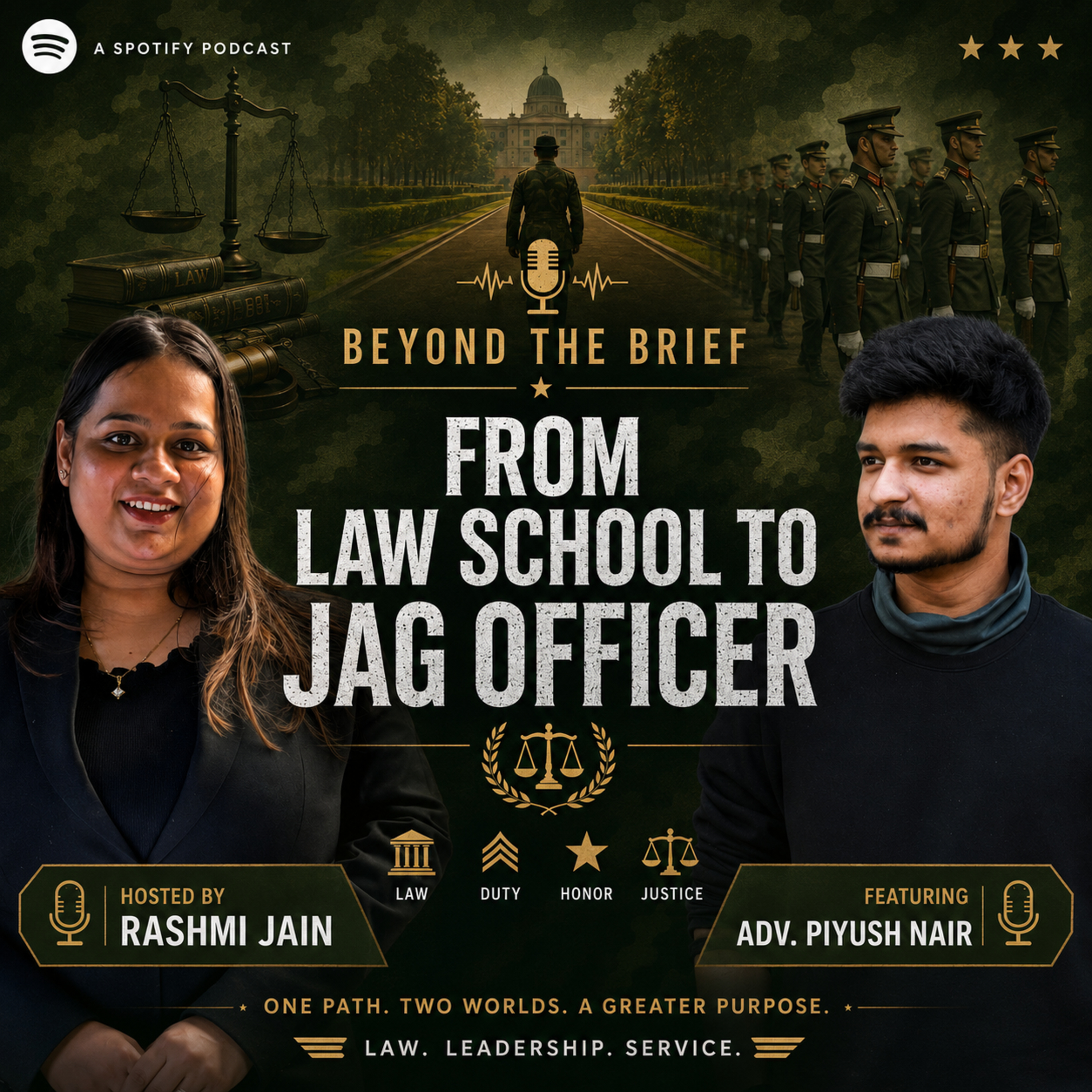
In our latest episode of Beyond The Brief, Adv. Piyush Nair answered these questions and shared practical insights from his own experience. Here's a simple guide to help you understand the journey from CLAT PG to the olive green uniform.
CLAT PG and eligibility
Many students think CLAT PG is only meant for pursuing an LL.M. or applying to PSUs. That is no longer the case.
CLAT PG is now mandatory for applying to the JAG entry. You don't need an exceptionally high score — in previous years the cut-off has been much lower than what is required for top NLUs or PSUs, though it is gradually increasing as more candidates become aware of this opportunity.
Use the correct year's score: only the CLAT PG score mentioned in the recruitment notification will be accepted. And check the eligibility carefully — candidates must have a recognised law degree and meet the age criteria mentioned in the official notification.
The SSB call letter
Once you clear the cut-off and receive your call letter, the next step is the Services Selection Board.
Candidates are allotted centres such as Allahabad, Bhopal, Jalandhar and Bengaluru. Many aspirants believe some centres are stricter than others, but your preparation should remain the same regardless of where you are sent.
Pack formal clothes, white shorts, sports shoes and your grooming essentials. The Army places great importance on discipline, and your appearance is part of that. Carry all your educational documents, including your 10th, 12th and law degree mark sheets, and keep DigiLocker ready in case you need a digital copy.
Day 1: Screening
The first day is the biggest elimination stage. A large number of candidates are screened out here.
The assessment includes the Officer Intelligence Rating, a time-bound test of reasoning and basic mathematics; the Picture Perception and Description Test, where candidates see a blurred picture for 30 seconds and write a story based on it; and a group discussion.
The group discussion is one of the most important parts of the day. Instead of trying to speak the most, focus on listening carefully, building on others' points and contributing meaningfully. As Adv. Piyush Nair puts it, don't turn the discussion into a fish market.
Day 2: Psychological tests
Once you clear the screening, the focus shifts from aptitude to personality.
The Thematic Apperception Test asks you to write stories based on a series of pictures, including one blank slide; the aim is to show a positive and practical approach. In the Word Association Test a word appears on the screen and you write the first meaningful sentence that comes to mind — avoid memorised lines, because the assessors want to understand how you naturally think.
The Situation Reaction Test gives you 60 situations and asks how you would respond; practical and balanced answers are valued more than dramatic ones. The Self Description Test asks how your parents, teachers, friends and you yourself would describe your personality.
Days 3 and 4: Group tasks
These two days test leadership, teamwork, communication and confidence.
Expect group discussions on current affairs, a Group Planning Exercise where your team solves a problem together, the Progressive Group Task and the Snake Race where teams cross obstacles using ropes and planks, individual obstacles that test stamina and determination, and a Command Task where you lead a small team.
One useful tip shared by Adv. Piyush Nair is to choose calm and cooperative teammates during the Command Task. Good leadership is not just about giving instructions. It is also about working well with your team.
The personal interview
The interview can happen any time between Day 2 and Day 4.
Expect questions about your family, education, hobbies, career plans and current affairs. Officers may ask several questions together to see how well you organise your thoughts and prioritise your answers. You may also be given legal or ethical situations to understand your decision-making.
One important point to remember is that your behaviour is observed throughout the SSB, not just inside the interview room. Even casual conversations can leave an impression.
The final conference
On the last day, every candidate appears before a panel of senior officers.
The panel compares the reports of the Psychologist, the Group Testing Officer and the Interviewing Officer. If they notice any differences, they may ask a few more questions before making the final recommendation.
Being recommended is a major achievement, but the journey does not end there. Candidates must still clear the medical examination and make it to the final merit list before joining the JAG Branch.
Final thoughts
One of the biggest takeaways from our conversation with Adv. Piyush Nair is that the SSB is much more than a selection process. It teaches discipline, confidence, teamwork, resilience and self-awareness. Even if you eventually choose a different career path, the experience can help you grow both personally and professionally.
If serving the country through law has ever been your dream, the JAG Branch is a career path worth exploring.
Disclaimer: eligibility criteria and the selection process may change over time. Always refer to the latest official JAG recruitment notification before applying.
Start a thoughtful conversation
Share a perspective, ask a relevant question or add a useful resource. Email addresses are kept private.
Be the first to add something useful to this conversation.